


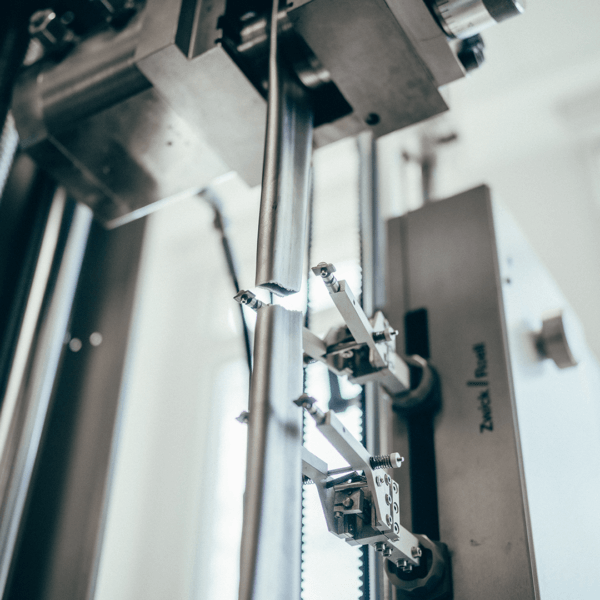
Around 50,000 tensile tests were documented at Schoeller in 2025 — an average of about 250 tensile tests per workday. This makes the tensile test the most important and most frequently used destructive testing method in the company. It provides crucial insights into the mechanical behavior of stainless steel tubes and serves as a key foundation for quality assurance.
The Tensile Test: Standard Method for Determining Mechanical Properties
The tensile test is a standardized destructive testing method in materials engineering. It is performed according to ISO 6892 and is used to determine the strength and deformation behavior of a material under uniaxial tensile stress. For stainless steel tubes, the test provides vital mechanical parameters such as tensile strength (Rm), yield strength (Rp0.2 or Rp1.0), and elongation at break (A).
The execution of the tensile test depends on the tube diameter. For tubes with smaller outer diameters, the test can be performed directly on the complete tube. The tube ends are clamped into special sample holders and tested under tensile stress.
For larger tube diameters, a so-called tube strip is extracted from the tube wall. This standardized sample is then tested in the tensile testing machine. Since tube strips naturally exhibit a curvature due to their geometry, the choice of clamping tools is particularly important. Specially adapted jaw inserts prevent unwanted deformations in the clamping area and ensure a compliant test according to standards.
The high number of tensile tests conducted annually highlights the significance of this method for quality assurance. The collected data enables a reliable evaluation of the mechanical properties of stainless steel tubes and provides the foundation for their use in demanding applications. In this way, the tensile test plays a crucial role in meeting the high requirements for quality, safety, and performance of the products in a verifiable manner.